Guide · around Château du Boscau
Martel
Martel from the château (25 km)
Martel, the “town of seven towers”, lies in the Lot, 25 km from Château du Boscau. Unlike most places in this series of guides, it didn’t grow up around a castle or a monastery, but at a crossroads of trade routes, where salt from the Atlantic coast and wine from Aquitaine came together.
The name probably comes from the medieval word for hammer (martel), a nod to the town’s past, with its forges and salt market.
From 1183, Martel was the capital of a viscounty under the authority of Turenne, governed by four consuls elected each year from the leading merchant families: a form of government common throughout southern France at the time.
From the château it’s just over 25 minutes’ drive.
What you'll see
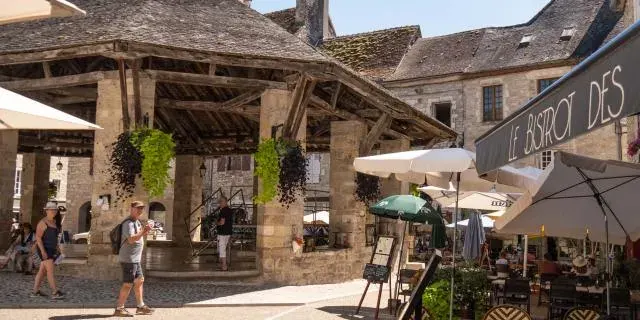
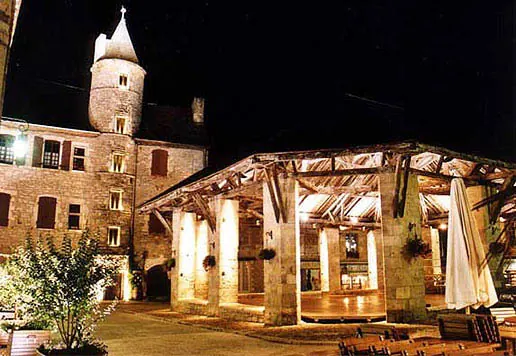
The heart of Martel is the Halle, the covered market hall on the central square, with the Hôtel Fabri beside it, one of the town’s merchants’ houses from the 13th to 15th centuries. The nickname “town of seven towers” dates from the 17th century and refers to the fortifications built in the 14th century. Every Wednesday and Saturday morning, all year round, the square around the Halle turns into a market, with producers and stalls from all over the region.
Wander the medieval lanes around the Halle, past the walnut oil mill and the many turrets of the merchants’ houses. At the end stands the Palais de la Raymondie, built from 1280 for the tax collector Bernard Raymond and only turned into the town hall after the French Revolution. The first floor houses the Musée d’Uxellodunum, with finds from the Puy d’Issolud: the hill where the Gauls made their last stand against Caesar in 51 BC, and which lies partly in the commune of Saint-Denis-lès-Martel, the village the steam train runs to.
A little further on stands the fortified church of Saint-Maur: a Gothic building with a 48-metre octagonal bell tower with four bastions, built between 1522 and 1531 on top of its Romanesque predecessor of 1140. Battlements, arrow slits and a wall-walk make it clear that the church also served a defensive purpose. In 1906 it became the first building in Martel to be listed as a Monument historique, thanks in part to its stained glass of 1518 and the Romanesque tympanum, the only remnant of the first church.

By steam train into the valley
Since 1997, a heritage steam train has run between Martel and Saint-Denis-lès-Martel, along the route of the former Bordeaux–Aurillac railway line, which closed to regular passenger traffic in 1980. The journey takes you through the valley along the Dordogne. Among fans of the little line, the train is also known as the “Truffadou”.
Gluges, the hamlet hugging the cliff (22 km)
Just south of Martel, beneath the limestone cliffs along the Dordogne and about 22 km from the château, lies Gluges: a former fishing hamlet, partly built up against the rock. A waymarked footpath, part of it a “chemin botanique” through the woods, links Martel directly to Gluges: a quiet walk across the plateau, with a good stretch of downhill over the last kilometre to the hamlet.
The church of Notre-Dame de l’Immaculée Conception, a 19th-century neo-Romanesque building, is literally built into the rock face. In the late 1950s the singer Édith Piaf came here regularly to pray; one day she anonymously paid for new stained-glass windows, including a rose window featuring a dove. The gift only came to light after her death.
From the nearby Belvédère de Copeyre viewpoint you look out over the Cirque de Montvalent, where the Dordogne winds in a wide loop around the village.
When to go
You can visit Martel all year round, but it’s busiest around the Halle in July and August, with the café terraces full and the steam train on its summer timetable. Outside the high season you’ll often have the streets almost to yourself.
Of the lovely villages and small towns around Château du Boscau, Martel is the largest. You can park for free under the plane trees along the main road. Saturday is always a good day, as there’s a large market in the covered market hall. Very French and very convivial.
Combine with
Martel lies on the route between the château and Rocamadour: see our guide to Rocamadour. For the villages closer to the château, such as Carennac, see our area guide.
Gluges is very close to Martel, so take it in on the same trip, especially if you like small, quiet places. Further along this route lies Souillac, with the Grottes de Lacave: our guide to Souillac covers that combination.
Where to stay near Martel
From the château you can be in Martel in just over 25 minutes. Gilles del Bosc is our self-catering apartment for 4, with two bedrooms and its own kitchen. Louis IX is a self-catering apartment for 2, with its own terrace. Jean Mouliérat is our B&B room for 2, on the first floor of the château itself.
By arrangement you can join our table d’hôtes, with a three-course dinner of fresh produce, as local and organic as possible.
For a lovely lunch, try restaurant Le Sans-Lys, easy to find by the roundabout. Excellent pizzas!
For lunch, the plat du jour at Maison Sophie on the Place des Consuls is well worth it: seasonal, with produce from local farmers.
Martel suits every stay
Pick one of the stays as your base, and make Martel part of your time in the Lot.