Guide · around Château du Boscau
Castelnau-Bretenoux
Castelnau-Bretenoux, opposite the château
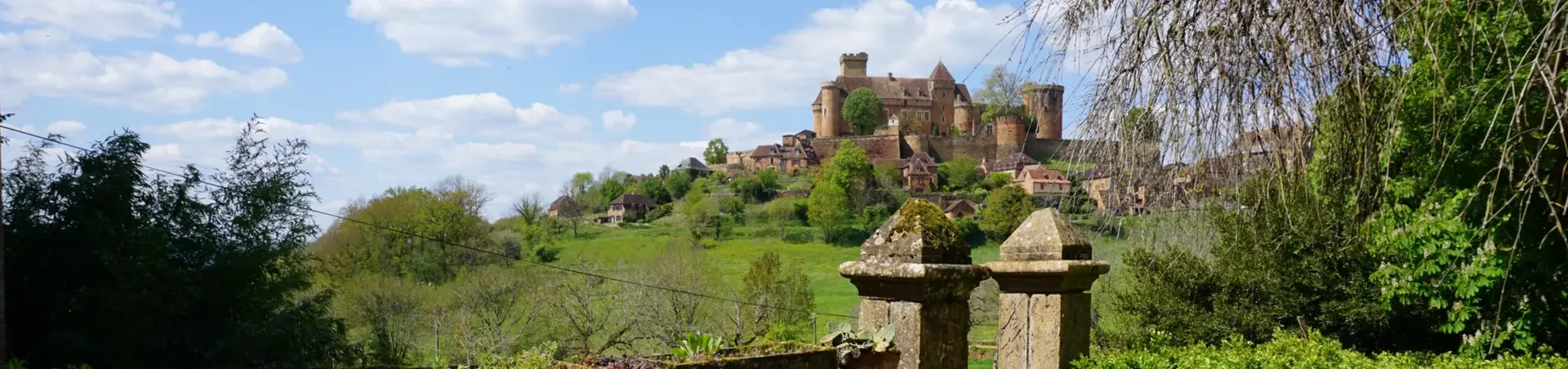
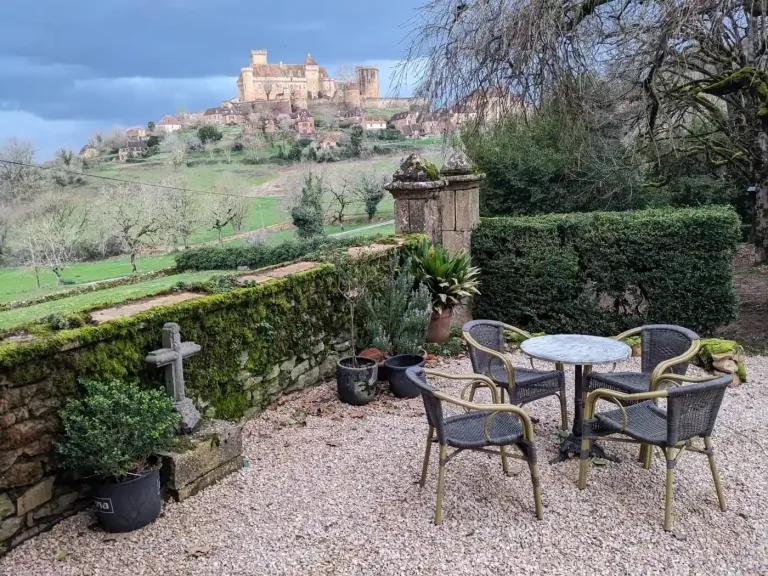
From our own garden you look straight across at Castelnau-Bretenoux castle: it’s within walking distance, on the other side of the valley. No other place in these guides is as close.
The two châteaux have been neighbours since the early Middle Ages: Castelnau-Bretenoux high on the hill, Château du Boscau down in the valley. As well as Castelnau-Bretenoux, the Collégiale St Louis and the villages of St Martin du Bois, Prudhomat and Felines are all within walking distance of our château.
That same Collégiale St Louis still holds relics of King Louis IX — the king after whom our self-catering apartment Louis IX is named. So two of our three stays bear names directly linked to this hill and this valley.
The connection with our château
The two châteaux have known each other for almost eight hundred years. In 1219 the archives record a dispute between the lords of del Bosc and their neighbours at Castelnau-Bretenoux castle. After the death of the man who built our house, the monk Gilles del Bosc, Boscau passed to the Baron of Castelnau, who gave it to his butler. Until the French Revolution the house served as a kind of guest house for Castelnau-Bretenoux castle — long before we began welcoming guests here ourselves.
Read the full history of our château, from around 1100 to today, on the history page.
What you'll see
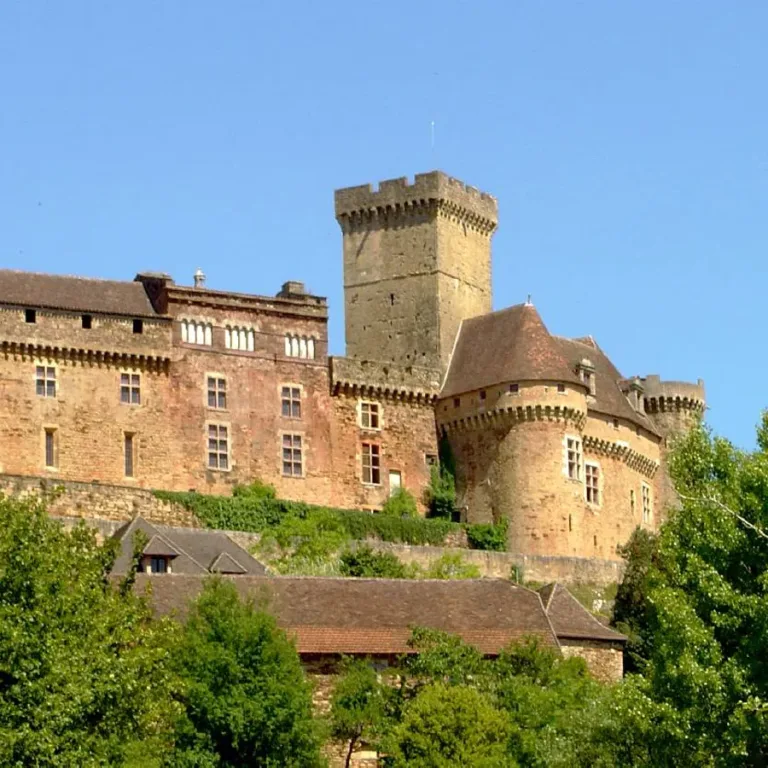
The oldest parts of Castelnau-Bretenoux castle date back to around 1100, when Baron Hugues had a “castel nau” (new castle) built on this hilltop. The residential tower and the keep were added in the 13th century, and an imposing gatehouse tower in the 14th; by the 16th century the castle had taken on its distinctive triangular shape, with two large wings and an artillery tower.
In the 16th and 17th centuries, under the Clermont-Lodève family, the austere fortress was transformed into a luxurious residence, with painted ceilings, larger windows, a grand balcony overlooking the valley and covered galleries.
After a fire in 1851 the castle fell into disrepair, until the Parisian opera singer Jean Mouliérat bought it at auction in 1896. He had sung at the Opéra-Comique in Paris for almost twenty years and used his fortune to restore the castle between 1896 and 1932, filling it with furniture, paintings, tapestries and sculpture — among his guests were the sculptor Rodin and the writer Colette. On his death in 1932 he left everything to the French state: the castle has been a listed national monument ever since, open to the public through the Centre des monuments nationaux.
Our B&B room Jean Mouliérat is named after him.
Bretenoux, the town on the Cère (2 km)
Bretenoux lies 2 km from the château, down in the valley on the Cère, directly opposite the hill of Castelnau-Bretenoux. Baron Guérin de Castelnau founded the town in 1277 as a bastide: a planned new town with a regular street grid around a central square, a model that lords in the Lot used at the time to attract new settlers to their lands. Anyone who settled in Bretenoux was exempt from tolls and granted fishing rights on the rivers — attractive terms for the time.
One gate survives from the old town walls; it once looked straight out over the Cère. The medieval Place des Consuls, with its cobbles and covered arcades, is still the heart of the town, surrounded by timber-framed houses; on market days the square fills with stalls and colour.
Bretenoux is also home to the nearest railway station to our château: Bretenoux-Biars, on the Brive–Aurillac TER line, about 5 km away. Handy if you’re arriving by train, or for a day out in the area without a car.
When to go
Because Castelnau-Bretenoux is so close by, you don’t need to set aside a whole day for it as you would for Rocamadour or Padirac. You can just pop over whenever it suits: before dinner, after breakfast, or simply because you’ve spotted the castle from our garden and got curious.
That also makes it the obvious choice for a day when you’d rather not drive far: a short walk or bike ride, a visit to the castle, and back in time for the tea garden the same afternoon.
Our view of the second-largest fortified castle in France is fantastic, and different at every moment of the day. Even so, the finest moment is often sunset or sunrise in summer. The light is glorious then: because the castle stands on top of a hill, it always catches the first and the last light of the day. Like something out of a fairy tale.
Combine with
Bretenoux, an old bastide town with shops and pavement cafés, is 2 km away, and Saint-Céré, also known as little Venice, is 8 km away. Beaulieu-sur-Dordogne (11 km), on the banks of the Dordogne, is a third option: Castelnau-Bretenoux is even listed as one of the sights to visit from there. Autoire and Loubressac, both 6 km away, also combine well with a visit here.
That way you can put together a varied day without spending long in the car: first the medieval hill of Castelnau-Bretenoux, then one of the river villages round about, and back to the château itself at the end of the day.
From the castle, a half-hour walk has been marked out that passes our château too. Be sure to stop at the Fontaine du Boscau: a medieval washing place with a medieval basin where freshly caught fish from the Dordogne were kept until they were eaten. Both monuments have recently been fully restored.
Back to the château
Castelnau-Bretenoux is the only place in this series of guides where “back to the château” involves almost no driving. By arrangement we serve a three-course table d’hôtes dinner of local and organic produce, or you can enjoy a pot of tea and something sweet in our own tea garden — with, of course, a view of the castle you’ve just visited.
Our favourite restaurant is Les Remparts, on the far side of the castle of Castelnau. We can walk there, the view is fantastic and you can enjoy the sunset; the food is excellent and the staff are friendly. Whenever our guests ask where to eat well, this is always the first place we recommend.
Our neighbour across the valley suits every stay
Pick one of the stays as your base, and look out from our garden on eight hundred years of neighbourly history.